

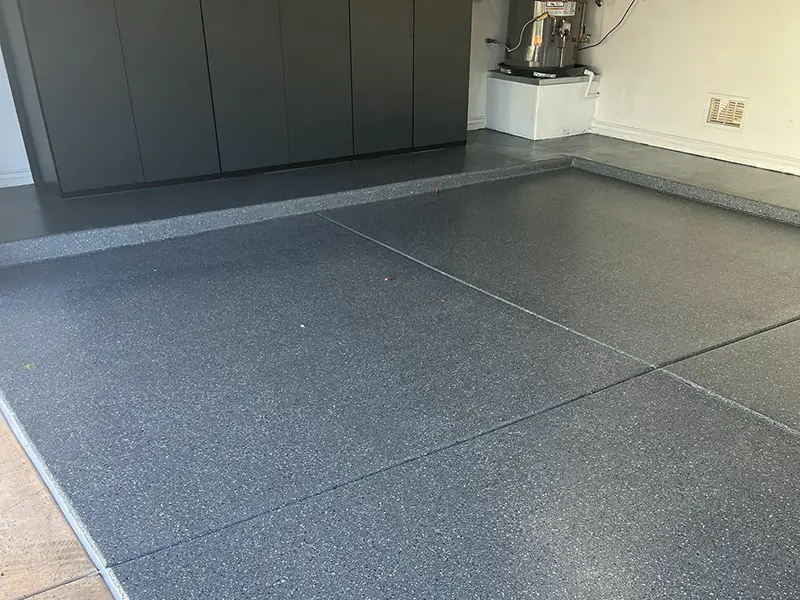
t’s a fair question and honestly it’s the one we hear before any other. You’ve probably driven past a garage somewhere with a coating that’s flaking off in sheets or curling up along the edges, chipping a little more every time somebody drops a tool on it. Spending real money on a floor and then watching it come apart a year later is nobody’s idea of a good time.
Epoxy can peel and it can chip. We’re not going to pretend otherwise. The part people get wrong is why it happens, because nine times out of ten when we get called to fix one of these, the coating was never the issue. Whoever put it down skipped the prep.
Why floors actually fail
Most folks don’t think about what’s going on underneath, which is understandable. But a coating can only hold as well as the surface it’s stuck to. Concrete looks like a solid slab and it really isn’t. It’s porous, kind of like a hard sponge, and over the years it soaks up dust and oil and whatever old sealer was on it before. Put epoxy straight over all that and there’s nothing for it to lock into. It just kind of floats on top.
And then it peels. Not because the product was bad but because it was never bonded down to begin with.
Moisture is the other one that gets people. Even here, a slab can wick vapor up out of the ground, and when that vapor hits the bottom of a sealed coating with nowhere to escape, it’ll push the whole thing loose over time. We check for that before we start anything. It’s one of those steps the cut-rate crews leave out because it costs them time and they’d rather be on to the next job.
The Arizona heat factor
Our weather doesn’t make any of this easier either. Picture your car after it’s sat in a parking lot all afternoon in July, those tires coming home at god knows what temperature. A cheap coating can’t deal with that kind of heat. The rubber more or less sticks to the floor and lifts the coating off when you back out. Hot tire pickup, they call it, and around here it’s probably the number one killer of bargain garage floors.
None of the fix is complicated though. You use materials that are actually rated for our climate and you bond them into the concrete properly. Do that and the heat stops being a problem.
What we do differently
Every floor gets ground down with industrial diamond grinders first. That’s what opens the concrete up and gives the coating a surface it can really bite into. Cracks get filled, low spots and pitting get patched, and we prime before the color ever goes on so you’re not left with weak spots hiding under there.
Our topcoats are polyaspartic, which holds up to the heat and the sun a whole lot better than the box-store epoxy kits. It won’t go brittle on you. It won’t yellow. And those hot tires that wreck a cheap floor? Doesn’t faze it.
Now, can a floor we install ever chip? Drop something heavy and sharp from the right height and yeah, you can ding just about any surface, ours included. But that’s a different animal from the wholesale peeling and flaking you’re picturing. That kind of failure comes from somebody rushing the job, not from epoxy being epoxy.
The bottom line
Installed the right way, an epoxy or polyaspartic floor is going to give you years without peeling or chipping on you. The whole thing hinges on who’s doing the work and whether they actually put in the prep time or just slap it down and leave.
Already stuck with a floor that’s lifting? Don’t write it off yet. A lot of the time we can grind it back, sort out whatever went sideways underneath, and lay it down again correctly.
Want to find out if your garage is a good candidate? Reach out for a free quote and we’ll come take a look. Call 480.205.7442 or request a quote online.