

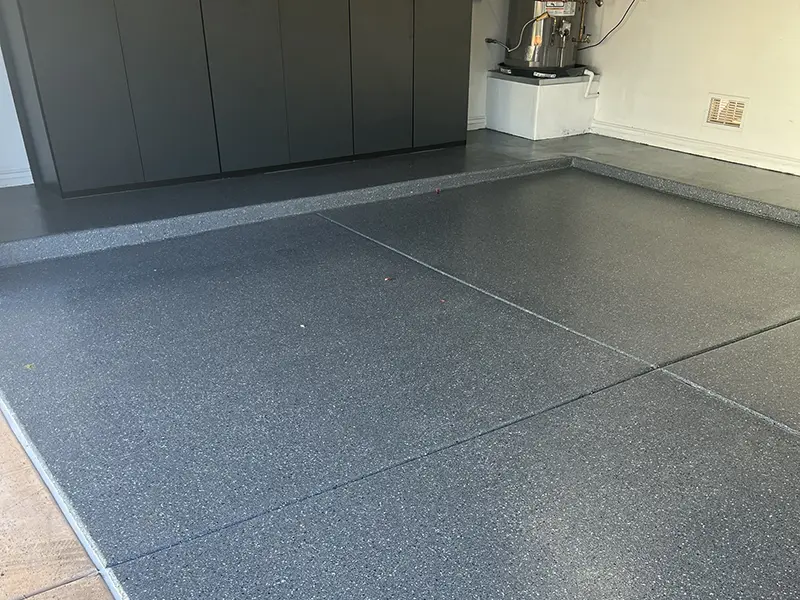
If you’re thinking about upgrading your garage or even a commercial space, you’ve probably seen those really clean “before and after” shots of shiny, flake-finish floors. They look tough as hell. But if you’ve ever seen a DIY job start peeling up under a car tire, it makes you question how durable it really is.
A properly installed epoxy floor shouldn’t be peeling or chipping under normal use. When it does, there’s usually a reason behind it, and it’s something worth understanding before you spend the money.
The Difference Between “Paint” and “Epoxy”
Most of the time, peeling comes down to confusion about what’s actually being used. A lot of big-box store “epoxy kits” are basically just water-based acrylic paint with a small amount of epoxy mixed in. It goes on like paint and dries the same way, just through evaporation.
Real epoxy flooring is a different animal. It’s a two-part system that chemically reacts and hardens into a solid surface. It doesn’t just dry, it cures. When it’s done right, it bonds directly to the concrete. If you’re seeing peeling that looks like a bad sunburn, chances are it wasn’t true epoxy to begin with, it was more like a coating sitting on top.
The Culprit: Poor Surface Preparation
In the flooring industry, we have a saying: A floor is only as good as the prep work. Imagine trying to tape two pieces of dusty sandpaper together. They won't stick. The same logic applies to concrete. If an installer simply mops the floor and starts pouring epoxy, the coating will sit on top of the "laitance"—a weak, milky layer of concrete dust. Over time, or under the heat of a car tire, the epoxy will pull that dust right off the surface, leading to "hot tire pick-up."
To prevent peeling, professionals use:
- Diamond Grinding: Using heavy machinery to "open" the pores of the concrete.
- Shot Blasting: Using metal beads to strip away contaminants.
- Moisture Testing: Ensuring there isn't water vapor rising through the slab that will push the epoxy off from underneath.
Can Epoxy Actually Chip?
While peeling is a bond issue, chipping is usually an impact issue. Standard epoxy is incredibly hard, which is great for scratch resistance, but it can be brittle. If you drop a 50-pound sledgehammer from six feet up, a standard epoxy might crack or chip.
This is why modern commercial epoxy flooring often utilizes a multi-layer system. By incorporating a flexible base coat and a polyaspartic topcoat, the floor gains "impact resistance." It’s able to absorb the shock of a dropped tool or heavy machinery without the surface fracturing.
The "Arizona Factor": Heat and Expansion
For those of us in the Southwest, the environment plays a massive role in floor longevity. Concrete expands and contracts as the temperature swings from a 115-degree afternoon to a 60-degree night.
If the epoxy used is too rigid or was applied to a damp slab during monsoon season, the internal pressure can cause the floor to delaminate. High-quality residential epoxy flooring is engineered to have a slight degree of thermal flexibility, allowing it to breathe with the Arizona concrete rather than fighting against it.
Signs Your Floor Was Installed Correctly
If you are inspecting a finished job or looking at a contractor's portfolio, look for these signs of a "peel-proof" floor:
- Mechanical Profile: You shouldn't see smooth concrete anywhere near the edges; it should look like fine-grit sandpaper before the coating goes down.
- Full Flake Broadcast: In residential settings, a "full flake" spread provides an extra layer of protection that hides minor substrate imperfections and adds structural integrity.
- Wicking Action: The primer should look like it has "soaked in" to the floor, not just sat on top like a sheet of plastic.
Why Quality Matters
At the end of the day, a floor that peels in two years is more expensive than a premium floor that lasts twenty. Repairing a failing epoxy floor requires stripping the old material entirely—a labor-intensive process that costs more than the original installation.
When you choose a professional grade system, you aren't just paying for the shine; you’re paying for the chemical bond that ensures the floor stays exactly where you put it.
Protect Your Investment
If you’re tired of looking at stained, dusty, or peeling concrete, it might be time to move away from the hardware store kits and toward a permanent solution. A garage or warehouse floor is a heavy-traffic environment that deserves a heavy-duty surface.
At Floor Kings, we don't just "paint" floors; we engineer them to withstand the specific rigors of the Arizona climate. From meticulous diamond-grinding prep to industrial-strength topcoats, we ensure your surface is chip-resistant and peel-proof for the long haul.
Want to see the difference a professional bond makes? Explore our process and see our latest projects at floorkings.com to get started on a floor that actually lasts.